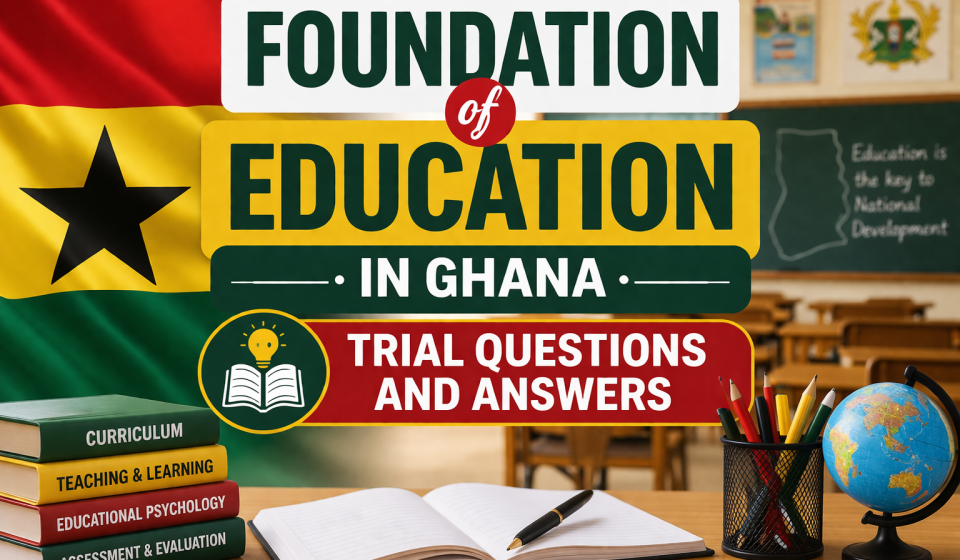
Foundation of Education in Ghana – Sample Trial Questions and Answers

Section A
Instructions: Choose the option that best completes each statement.
- A false belief that negatively affects teaching and learning is known as…
A. perception
B. philosophy
C. misconception
D. attitude - One common misconception about teaching in Ghana is that…
A. teaching requires training
B. teaching is professional
C. anyone can teach
D. teaching requires certification - Inclusive education ensures that…
A. only brilliant learners are taught
B. only disabled learners are supported
C. all learners learn together regardless of differences
D. only girls are supported - Special Education Needs (SEN) refers to…
A. only physical disabilities
B. additional support needed by some learners
C. only mental disabilities
D. teacher training - Gender discrimination in education mainly affects…
A. boys
B. teachers
C. girls
D. parents - One barrier to girls’ education in Ghana is…
A. free education
B. technology
C. cultural beliefs
D. textbooks - The National Teachers’ Standards (NTS) were developed to…
A. punish teachers
B. guide students
C. improve teaching quality
D. control schools - One domain of the NTS is…
A. communication skills
B. leadership
C. professional values and attitudes
D. supervision - Another domain of NTS is…
A. discipline
B. professional knowledge
C. guidance
D. testing - The third domain of NTS is…
A. communication
B. leadership
C. professional practice
D. curriculum - A good teacher is expected to be…
A. lazy
B. biased
C. committed
D. harsh - The basic education curriculum in Ghana is divided into…
A. two phases
B. three phases
C. four phases
D. five phases - Which of the following is a phase of basic education?
A. tertiary
B. university
C. JHS
D. college - Assessment benchmarks are used to…
A. punish students
B. measure learning progress
C. select teachers
D. promote schools - Philosophy of education deals with…
A. teaching methods
B. beliefs and ideas about education
C. school buildings
D. discipline - Sociology of education studies…
A. school rules
B. relationship between society and education
C. teaching methods
D. exams - One sociological factor influencing education in Ghana is…
A. weather
B. culture
C. food
D. language only - A teaching philosophy is…
A. lesson plan
B. syllabus
B. a teacher’s belief about teaching
D. curriculum - School-community partnership refers to…
A. teachers working alone
B. cooperation between school and community
C. parents teaching
D. government control - One benefit of school-community partnership is…
A. conflict
B. support for learners
C. punishment
D. isolation - Technology in education helps to…
A. distract students
B. waste time
C. improve teaching and learning
D. reduce knowledge - A misconception about ICT is that…
A. it helps learning
B. it is difficult to use
C. it supports teaching
D. it improves skills - One negative effect of technology is…
A. learning
B. communication
C. addiction
D. collaboration - ICT integration means…
A. avoiding technology
B. using technology in teaching
C. removing computers
D. ignoring media - A teacher must show commitment by…
A. being absent
B. preparing lessons well
C. ignoring learners
D. avoiding class - Lifelong learning means…
A. learning ends at school
B. continuous learning throughout life
C. only formal learning
D. short-term learning - Continuous Professional Development (CPD) helps teachers to…
A. retire early
B. improve skills
C. avoid work
D. reduce knowledge - A teacher as a change agent means…
A. refusing change
B. bringing positive change
C. avoiding community
D. ignoring learners - Inclusive classrooms should…
A. exclude disabled learners
B. support all learners equally
C. favor boys
D. ignore diversity - Multigrade teaching involves…
A. one subject only
B. teaching different classes together
C. only adults
D. one learner - One strategy for inclusion is…
A. punishment
B. discrimination
C. differentiated instruction
D. isolation - Prejudice in education leads to…
A. fairness
B. bias and discrimination
C. equality
D. inclusion - The concept of education includes…
A. only schooling
B. formal, informal and non-formal
C. only informal
D. only formal - Informal education occurs…
A. only in school
B. outside school settings
C. only in class
D. in exams - Formal education is…
A. unplanned
B. structured learning in schools
C. random
D. informal - Non-formal education is…
A. school only
B. organized learning outside formal system
C. informal only
D. no learning - One characteristic of a good teacher is…
A. bias
B. lateness
C. fairness
D. anger - The curriculum is…
A. school building
B. planned learning experiences
C. teachers
D. exams only - Assessment helps teachers to…
A. punish learners
B. evaluate learning
C. ignore learners
D. dismiss students - Culture affects education by…
A. having no influence
B. shaping beliefs and practices
C. reducing knowledge
D. avoiding learning - A barrier to inclusion is…
A. support
B. fairness
C. negative attitudes
D. equality - Equity in education means…
A. treating all the same
B. fair treatment based on needs
C. discrimination
D. exclusion - Equality in education means…
A. same opportunities for all
B. discrimination
C. bias
D. exclusion - Teachers should use ICT to…
A. avoid teaching
B. enhance learning
C. punish students
D. reduce effort - A reflective teacher is one who…
A. ignores feedback
B. thinks about their teaching
C. avoids learning
D. rejects ideas - The role of a teacher includes…
A. punishing only
B. guiding learners
C. ignoring learners
D. controlling parents - Learning occurs when…
A. no change happens
B. behavior or knowledge changes
C. students sleep
D. teachers talk only - One aim of education in Ghana is to…
A. reduce skills
B. develop individuals fully
C. discourage learning
D. limit growth - ICT tools include…
A. chalk only
B. books only
C. computers and internet
D. desks - Teaching is considered a profession because it…
A. requires no training
B. requires specialized knowledge and skills
C. is easy
D. is informal
SECTION B
1a) Describe four characteristics of an educable child.
b) Explain four ways a teacher can help such a child.
2. Discuss five benefits of technology in the classroom.
3.a) What is school-community relationship?
b) As a headteacher, give five strategies to improve it.
4. a) Briefly define the following concepts:
- i) Education
- ii) Culture
- iii) Curriculum
b) State the relationship between the following concepts:
- i) Education and Culture
- ii) Education and Curriculum
- iii) Culture and Curriculum
5. Explain any five (5) strategies you will use in teaching the visually impaired in an inclusive classroom.
6. Discuss any five (5) objectives of the new B.Ed Curriculum.