






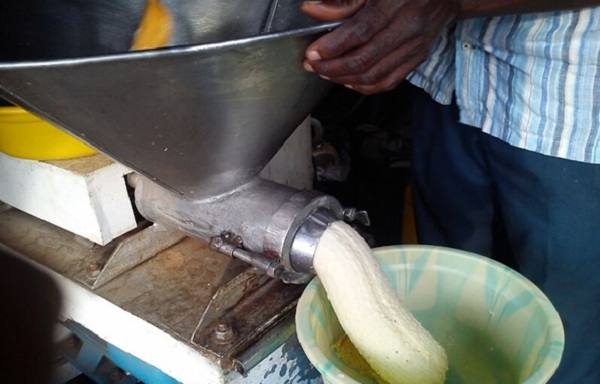
The growing use of machines to prepare fufu in Ghanaian homes and food businesses has made life easier for many people. What once required hours of pounding can now be done within a much shorter time using a machine.
However, an Agricultural Engineering professor at the University of Cape Coast (UCC) has raised concerns about the safety of some locally fabricated food-processing machines, including fufu pounding machines.
According to Ing. Prof. Francis Kumi, Head of the Department of Agricultural Engineering at UCC, some locally manufactured machines are produced without following proper safety and quality standards.
Concerns Over Locally Made Machines
Prof. Kumi explained that some local fabricators do not follow internationally accepted standards when producing machines.
He said a study conducted by his team found that many fabricators make machines based on their own methods without paying enough attention to established standards.
“A study we did showed that many fabricators do not follow international standards; they just do anything.”
He noted that the fufu pounding machine is one example of equipment that has become common because it helps people save time and energy.
While acknowledging the important role played by local artisans, Prof. Kumi said there is a need to ensure that machines used for food preparation are properly designed, tested and made with suitable materials.
Pounding or Grinding?
Another concern raised by the professor is the way some machines are being designed and used.
According to him, some machines that are described as fufu pounding machines are actually designed to grind the food rather than pound it in the traditional way.
“Many local artisans are now turning it into a grinding machine instead of pounding.”
He explained that although people commonly use the word “grind” when referring to the preparation of fufu, there is a difference between pounding and grinding.
The concern is therefore not only about the method of preparing fufu but also about the design, construction and materials used in the machines.
The Materials Used Could Be a Problem
Prof. Kumi also raised concerns about the materials used to manufacture food-processing machines.
He stressed that machines that come into direct contact with food should be made from appropriate food-safe materials, particularly suitable grades of stainless steel.
“We know food processing machines should be made with stainless steel. Even with stainless steel, there are grades.”
He questioned whether all locally fabricated machines advertised as stainless steel are actually made from the appropriate grade.
According to him, some machines may contain mild steel or galvanised steel that has simply been painted to make it appear shiny.
“Some use mild steel and galvanised steel, then paint it. You go and see it shiny and think it is stainless steel – but it is not.”
This, he warned, could create problems when parts of the machine come into contact with food over time.
Possible Health Risks
The professor warned that poor-quality materials used in food-processing equipment could potentially wear out, rust or contaminate food.
“Some of them wear into our food. Some get rusted.”
He said consumers may not immediately notice the problem, making it important for authorities and manufacturers to take the issue seriously.
Prof. Kumi further warned that repeated exposure to contaminants from poorly manufactured machines could have health implications.
“This can kill you slowly without you knowing.”
He therefore called for greater attention to the quality and safety of locally fabricated food-processing equipment.
Need for Proper Standards
Local machine fabrication plays an important role in Ghana because it creates jobs and provides affordable equipment for households and businesses. However, Prof. Kumi believes local production should go together with proper standards and quality control.
He called on relevant institutions to critically examine the situation and ensure that food-processing machines meet appropriate safety requirements before they are widely used.
“Let’s look at this critically. I think it is something the nation must pick up and really pay attention to.
WATCH VIDEO HERE https://x.com/SIKAOFFICIAL1/status/2098009362404921669
What This Means for Consumers
The concerns raised by Prof. Kumi highlight the importance of being careful when purchasing or using locally fabricated food-processing machines.
Consumers may need to ask questions about the materials used, how the machine was manufactured and whether it has undergone proper testing.
The popularity of fufu pounding machines is unlikely to disappear because they offer significant convenience. However, ensuring that these machines are safe, properly designed and made with food-safe materials is essential to protect consumers.
For now, the professor’s warning serves as a reminder that convenience should not come at the expense of food safety and public health.